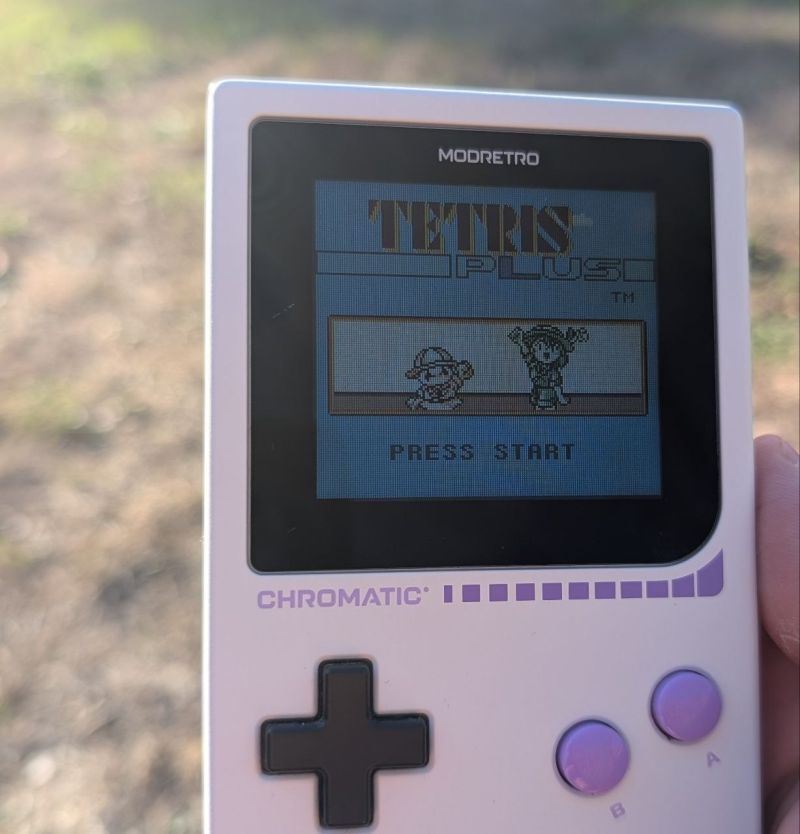
This version of Tetris Plus never existed!
I bought myself a Game Boy last year. I wanted something beautifully made, with modern touches like a magnesium case and Gorilla Glass. Mostly, though, I wanted to avoid the Netflix effect, where you can watch anything and have no idea what to put on.
With the Game Boy, it’s one cartridge, one game. No updates. Pop it in and play.
One day, I found out in conversation that Tetris Plus had come out on the Game Boy. I’d loved the PlayStation version as a kid!
But… it wasn’t in colour. That gave me an idea for a challenge. I had only a hazy idea of how the Game Boy worked, and I hadn’t touched assembly language since school. Could AI handle something like this?
What made it interesting was that Claude still struggled with visual tasks, and it would have to get to grips with a hardware architecture few people use anymore (though the Game Boy scene is still big and active).
I spent quite a few evenings getting nowhere with the early Opus models. Once we’d decompiled the code, we couldn’t add anything because the memory addresses were hard-coded. We had to set up tests and refactor the code. The colours were inconsistent. A colour used in one spot on one screen would turn up in the same spot on the next. I had some reading to do.
We started building tools so I could do some of the colouring by hand.
It looked better, but I still wasn’t happy with it.
Then along came Fable… It got the colours of the pieces, the menus and, best of all, the sprites almost in one shot. We built a tool and tweaked it a few more times to finish colouring the last few screens.
And why stop there? We made a few things nicer for the player. You can now skip the long opening disclaimer. If, like me, you tend to hammer the buttons, you can get past the “Continue” menu by pressing A. We fixed some display bugs in the next-piece preview and corrected the code annotations too.
I really enjoyed this. It felt like a good collaboration between a human and an AI. I could bring the skills the AI still lacked, and it could build the tools I needed to put those skills to work.